Let’s talk about the most lied-about room in your home. You know the one. The space where you toss your keys, kick off your shoes, and dump the mail in a guilty pile. You call it a “mudroom” or a “foyer,” but let’s be honest—it’s a landing pad for chaos. And you’ve probably decorated the rest of your house while telling yourself, “I’ll figure out the entryway later.”
But here’s the secret every designer knows: The entryway isn’t a afterthought. It’s the opening sentence of your home’s story.
Think about it. It’s the first thing you see when you come home, setting the tone for your entire evening. It’s the last thing guests experience, leaving a final impression. It’s the psychological airlock between the frantic outside world and your personal sanctuary. A chaotic entryway means you start and end every day stressed. A calm, intentional one? It’s like a deep breath in physical form.
You don’t need a grand foyer. You just need a plan. Let’s transform those critical 25 square feet from a cluttered dumping ground into the most stylish and functional room in your house.
Part 1: The Psychology of the Threshold: More Than Just a Doorway
Neuroscientists have a term for what happens when you cross a threshold: “Event Boundary.” Your brain uses doorways and transitions to compartmentalize memories and tasks. Walking through your front door is a powerful cue. A messy, overwhelming entryway signals to your brain: “The chaos continues in here.” A clear, beautiful one signals: “You are now entering a place of order and calm.”
This space has two core jobs:
- The Welcome: For you and your family. It should make coming home feel like a relief.
- The Introduction: For guests. It should whisper (or declare) who you are and what they can expect.
Ignoring it is like writing a brilliant novel with a terrible first page. People might never get to the good part.
Part 2: The 4 Non-Negotiable Zones of a High-Functioning Entry
No matter the size, every entryway must perform these four functions. Your job is to solve for them, beautifully.
Zone 1: The Landing Strip (The “Drop Zone”)
- The Problem: Keys, wallets, mail, sunglasses, and masks form a pile of anxiety on your nearest flat surface.
- The Solution:Designate a specific, contained home for every item.
- A shallow bowl or tray for keys and pocket items.
- A wall-mounted file sorter or a dedicated drawer for incoming/outgoing mail.
- Hooks, not hangers. Hooks are one-motion easy. Install them at varying heights for adults, kids, and guests.
- Pro Tip: This zone needs to be within one step of the door. If it’s not effortless, it won’t be used.
Zone 2: The Ground Control (Shoe Management)
- The Problem: A tumbleweed of shoes tripping you every time you open the door.
- The Solution:Define the shoe space.
- A bench with storage underneath is the gold standard: you sit to put shoes on, and they hide away.
- A low, open shelf for daily shoes. Limit the space—this forces a “one-in, one-out” policy.
- A designated mat or tray for wet/muddy boots.
- Pro Tip: Keep only current season shoes here. All others belong in closets or bedrooms.
Zone 3: The Mirror Check (The Last Look)
- The Why: It’s not vanity; it’s function. A final check before you face the world, and it instantly makes the space feel larger and brighter.
- The How: Choose a mirror with presence. A round mirror softens angles. A large leaning mirror adds drama. Place it where it catches light and where you naturally turn for a glance on your way out.
Zone 4: The Soul Spot (The Personality)
- The Why: This is what turns utility into atmosphere. This is your “opening sentence.”
- The How: One to three intentional elements that bring you joy:
- A small piece of art that makes you smile.
- A vase with fresh or dried foliage.
- A great-smelling candle or diffuser.
- A beautiful, textured rug that defines the space.
Part 3: Small Space? Big Impact. Solutions for Every Footprint.
The “Wall Only” Entry (The Alley): You have a door and a wall. That’s it.
- Solution: Go vertical. A slim console table (even 6” deep). Above it, a mirror and two hooks. On it, a tray and a small lamp. Below it, a beautiful basket for shoes. You’ve created all four zones in 3 linear feet.
The “Door Opens Into the Living Room” Entry (The Non-Entry): You walk straight into the main room.
- Solution: Create a psychological zone. Use a room-defining rug. Place a console table behind your sofa as a “backstop.” Use a screen, a large plant, or a bookshelf turned sideways to create a subtle visual division.
The Narrow Galley Entry (The Pass-Through): A long, skinny hallway.
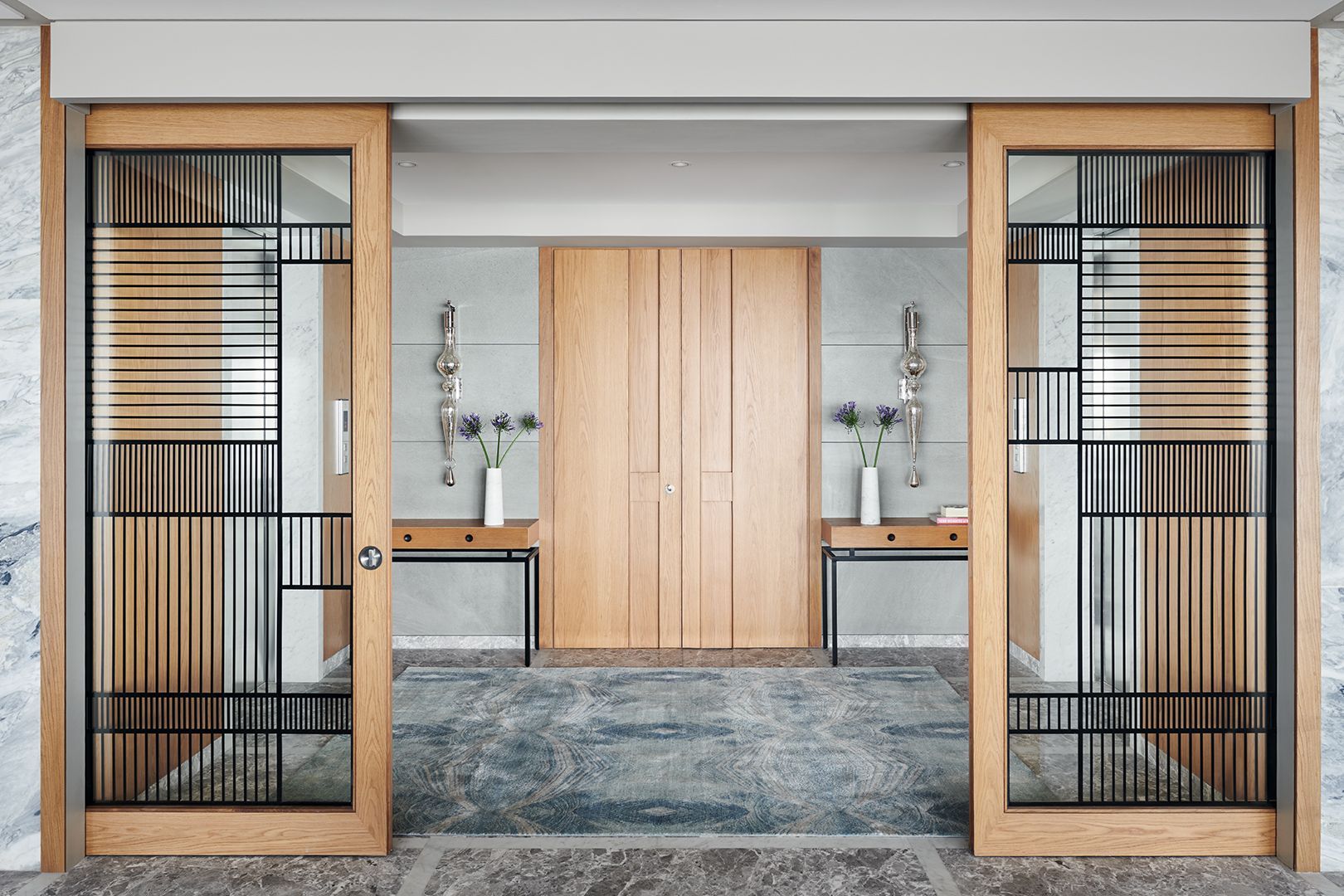
- Solution: Symmetry is your friend. Matching console tables or sets of hooks on both walls. A runner rug to lead the eye. A stunning pendant light or a series of sconces to draw the eye up.
The Generous Square Footage (The True Foyer):
- Solution: You have the luxury of furniture. An armoire or storage cabinet hides all clutter. A statement chandelier. A chair or bench that’s actually comfortable. An art gallery wall. Don’t just fill the space—curate it.
Part 4: The Style Formula: Curating Your First Impression
Your entryway is a capsule collection of your home’s style. It should hint, not scream.
- For a Modern Home: Sleek console, abstract art, a single sculptural object, a geometric rug. Keep it edited.
- For a Cozy, Traditional Home: A wood bench with a cushion, a framed gallery wall, a patterned runner, a lamp with a warm glow.
- For a Global/Boho Home: A rattan mirror, a pile of textured baskets, a vintage kilim runner, lots of greenery.
- The Universal Trick: Add a lamp. Overhead lights are harsh. A table lamp on a console (with a smart plug to turn it on at dusk) creates instant, welcoming warmth the moment you or a guest walks in.
Conclusion: Your Daily Dose of Calm
Transforming your entryway is the highest-impact, lowest-effort project you can do for your home and your mindset. It requires no renovation, just intention.
This weekend, tackle it. Empty it completely. Clean it. Then, add back only the solutions for the Four Zones. Finally, add your Soul Spot. When you’re done, walk out your front door, then turn around and walk back in.
Feel that? That’s the power of a great first impression—on your guests, and most importantly, on yourself. You haven’t just organized a corner. You’ve built a welcome mat for your own peace of mind.
FAQs: Your Entryway Questions Answered
Q1: I have NO storage—no closet, no space for furniture. What can I do?
A: Your best friend is the “Wall Organizer.” Get a beautiful, multi-functional piece that combines hooks, a shelf, and maybe a small mirror or chalkboard. Hang it right next to the door. Use the hooks for bags/keys, the shelf for a basket (holding hats/gloves) and a small plant. Below it, place a single, stylish boot tray for shoes. It’s a complete system in one footprint.
Q2: How do I handle family clutter (kids’ backpacks, dog leashes, sports gear)?
A: Assign color-coded, specific homes. Give each kid their own hook and a labeled basket or bin on a shelf for their gear. Install a dedicated hook for the dog leash with the poop bag holder attached. For sports gear, a large, lidded decorative trunk or bench can swallow bats, balls, and shin guards. The rule: if it doesn’t fit in its assigned home, it doesn’t stay in the entryway.
Q3: What kind of rug is best for a high-traffic, often wet entryway?
A: You need durability and cleanability. Skip delicate fibers.
- Top Choice: Ruggable or similar washable rug. You can literally throw it in the washing machine.
- Great Natural Options: Coir (jute), seagrass, or indoor/outdoor flatweaves. They are tough, hide dirt, and can be spot-cleaned or shaken out.
- Size Tip: Make sure it’s large enough for at least two people to stand on fully when they enter.
Q4: My entryway is dark. How can I make it feel brighter and bigger?
A: Mirror, Light, Paint.
- Mirror: A large mirror opposite or adjacent to the door will reflect any available light.
- Light: If you can’t wire a new light, use plug-in wall sconces or a console lamp with a bright, warm bulb (2700K). A statement pendant can also draw the eye up.
- Paint: Paint the walls and ceiling the same light, warm color (a creamy white, a very pale grey). Use a high-gloss or semi-gloss paint on the trim to reflect more light. A light-colored rug will also help.
Q5: Is it okay for the entryway style to be different from the rest of my home?
A: It should be a harmonious preview, not a separate show. It’s fine for it to be more dramatic or focused (a bold wallpaper you wouldn’t use in the living room), but it should share a common thread—a color, a material, a vibe—that connects it to the adjacent rooms. You’re setting the stage, not performing an unrelated play.