Walk into a room that feels effortlessly “done.” It’s not about one flashy piece. It’s a feeling—a sense of harmony, depth, and intention. You look around and see wood, but it’s not all matchy-matchy. You see metal, but it’s not all the same finish. You see stone or ceramic, adding a cool, solid weight.
This magic has a name: Material Alchemy. It’s the art of mixing different textures and finishes to create a space that feels collected, rich, and alive. It’s what separates a room that looks like it was bought in one day from a room that tells a story.
For too long, we’ve been sold matching sets and told that all our metals must be the same. The result? Spaces that feel flat, sterile, and soulless. The truth is, perfection is boring. It’s the thoughtful friction between a rough wooden table and a sleek steel lamp, between a fluted clay vase and a smooth marble side table, that creates visual interest and tactile delight.
Let’s ditch the rulebook and learn the language of materials. Let’s learn to mix, layer, and contrast to build spaces with soul.
Part 1: The Philosophy: Why Mixing Beats Matching
Think of materials like instruments in an orchestra. If every instrument played the same note at the same volume, it would be a drone. But when you combine strings, brass, woodwinds, and percussion—each with their own timbre, pitch, and weight—you get a symphony.
- Matching Says: “I bought a set.” It’s static, predictable, and lacks personality.
- Mixing Says: “I curated this over time.” It’s dynamic, personal, and full of narrative.
The goal isn’t chaos. It’s orchestrated contrast. You’re creating balance through variation, not uniformity.
Part 2: The Material Library: Know Your Players
To mix well, you need to understand the inherent personality of each material.
Wood: The Warm Soul
- Personality: Organic, warm, grounding, textured. It brings life and history.
- Key Varieties:
- Light & Airy: Oak, Ash, Maple. Feels Scandinavian, modern, casual.
- Warm & Mid-Tone: Walnut, Cherry, Teak. Feels rich, mid-century, sophisticated.
- Dark & Dramatic: Ebony, Stained Walnut, Wenge. Feels moody, formal, luxurious.
- Mix Tip: Vary the stain and grain pattern, not just the species. Pair a sleek, dark-stained walnut table with a light, raw oak chair.
Metal: The Structural Spark
- Personality: Industrial, sleek, reflective, durable. It adds structure and light.
- Key Finishes:
- Warm Metals: Brass, Gold, Copper. Feel luxurious, vintage, inviting.
- Cool Metals: Chrome, Nickel, Stainless Steel. Feel modern, crisp, clean.
- Dark/Brushed Metals: Black Iron, Matte Black, Brushed Bronze. Feel organic, understated, contemporary.
- Mix Tip: You can mix metal finishes! The key is dominance and distribution. Choose one primary finish (e.g., brushed nickel for all door hardware), then use a secondary finish as an accent (e.g., brass lamp bases).
Stone & Ceramic: The Earthy Anchor
- Personality: Cool, solid, timeless, textural. It grounds a scheme and adds permanence.
- Key Types:
- Veined & Dramatic: Marble, Quartzite. Makes a bold statement.
- Organic & Textured: Limestone, Travertine, Slate. Feels rustic, European, tactile.
- Smooth & Minimal: Honed Granite, Terrazzo, Glazed Ceramic. Feels modern, graphic, clean.
- Mix Tip: Use stone as a counterpoint. A rough limestone fire surround against smooth plaster walls. A sleek marble coffee table on a nubby wool rug.
The Supporting Cast:
- Glass & Mirror: Adds lightness, reflection, and space. Cuts visual weight.
- Natural Fibers: Linen, Cotton, Wool, Jute, Rattan. Add softness, texture, and an informal, breathable quality.
- Leather: Ages beautifully, adds a rich, warm patina and a touch of masculinity or vintage appeal.
Part 3: The Rules of Engagement: Principles for Perfect Mixing
- The 80/20 Rule: Let one material dominate (e.g., 80% wood tones in a room), then use the others (metal, stone) for the remaining 20% as accents. This creates cohesion.
- Vary the Scale of Texture: Pair a large-scale texture (a chunky knit throw) with a medium-scale texture (a ribbed velvet pillow) and a fine-scale texture (smooth ceramic). This creates depth.
- Balance Warm and Cool: This is the secret to a room that feels “just right.” A room with all warm woods and brass can feel stuffy. Add cool elements: a steel-framed chair, a marble side table, linen curtains. Conversely, a cool grey and chrome room needs the warmth of wood and leather to feel inviting.
- Mind the Shine (The Luster Scale): Mix matte (oiled wood, brushed metal, linen), satin (honed stone, aged leather), and high-gloss (lacquer, polished chrome, mirror) finishes. Too much matte feels flat; too much gloss feels cheap. A satin base with moments of matte and gloss is ideal.
- Create “Material Moments”: Intentionally pair two contrasting materials in one spot. A concrete lamp base on a live-edge wood table. A velvet pillow on a cane chair. These little moments are visual poetry.
Part 4: The Room-by-Room Mixology Guide
The Living Room: The Collected Gallery
- Scenario: Start with a large, textured wool sofa (soft/natural).
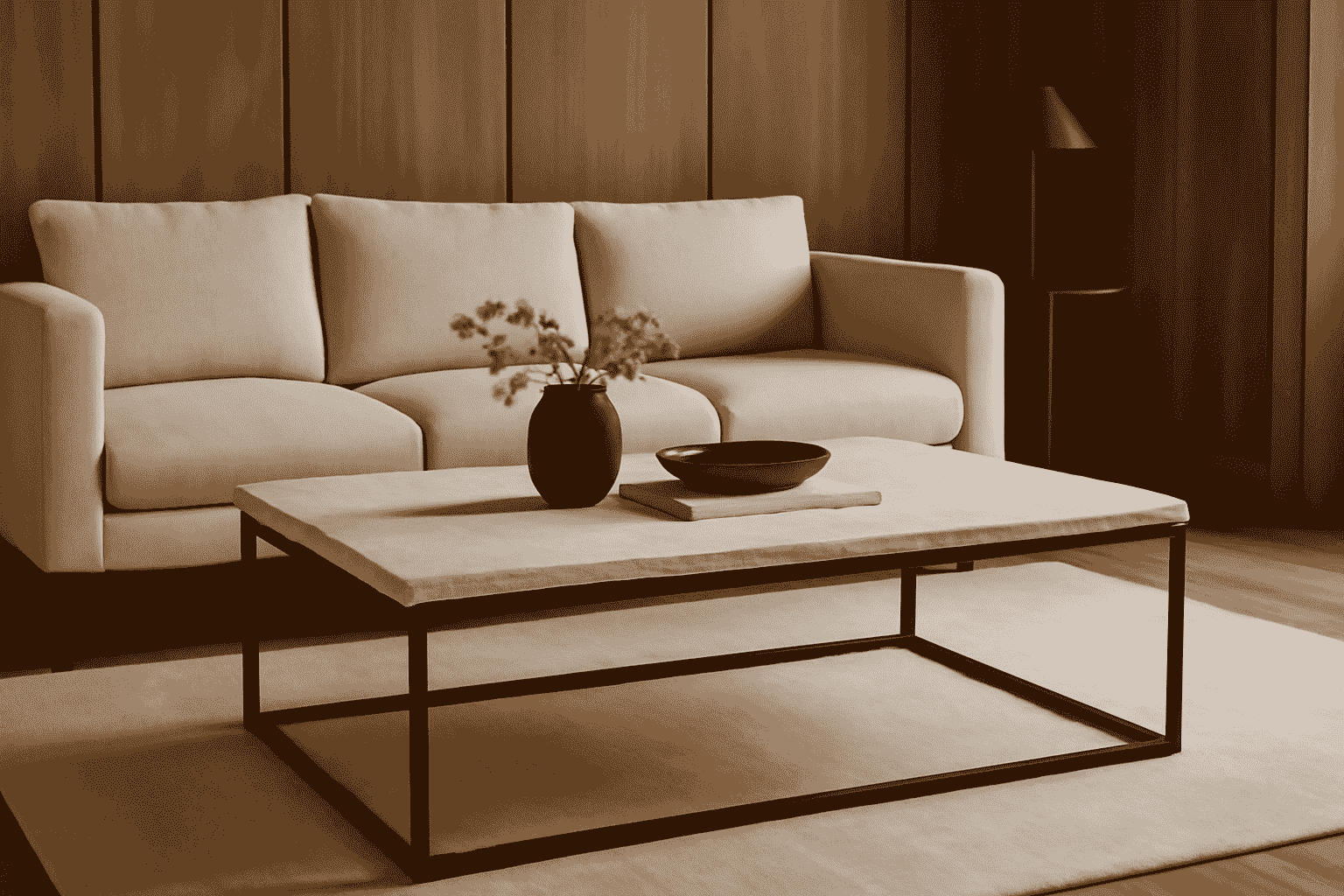
- Add: A walnut coffee table (warm/wood) with a black iron base (cool/metal).
- Layer: A marble tray (cool/stone) on the table, holding a brass candleholder (warm/metal).
- Anchor: A jute rug (natural/textured) underneath.
- Finish: Linen curtains (soft/natural) and a chrome floor lamp (cool/metal) in the corner.
- Why it Works: Warm vs. cool, matte vs. slight shine, hard vs. soft. Every material has a partner and a counterpoint.
The Kitchen: The Functional Studio
- Cabinet Strategy: Try oak upper cabinets (warm/wood) with matte black lower cabinets (cool/color).
- Countertops: Quartzite with grey veins (cool/stone) bridges the wood and black.
- Hardware & Fixtures: Brass pulls and faucet (warm/metal) to warm up the black and contrast the cool stone.
- Lighting: Pendant lights with glass globes and black cords (mix of glass/metal).
- Why it Works: The black is grounded by the warm wood and brass, preventing it from feeling too harsh. The stone ties it all together.
The Bedroom: The Textural Sanctuary
- The Bed: A upholstered bed in linen (soft).
- Nightstands: Rattan or cane nightstands (organic/textured/warm).
- Lighting: Ceramic table lamps in a matte glaze (cool/smooth) on the nightstands.
- Hardware: Brusthed brass knobs (warm/metal) on the nightstands.
- Layers: A sheepskin rug (ultra-soft) on a sisal rug (textured/natural).
- Why it Works: The dominant soft, natural textures (linen, rattan, sheepskin) create coziness. The cool, smooth ceramic and hints of metal provide just enough refinement and contrast to keep it from feeling too rustic.
Conclusion: Build a Story, Not a Set
Material alchemy isn’t about following a prescriptive recipe. It’s about developing an eye. It’s about touching samples, noticing how light plays on a brushed surface versus a polished one, and understanding the emotional weight of oak versus ebony.
Start by looking at one piece you love. What is it made of? Now, ask yourself: “What material would create an interesting conversation with this?” Not a clone. A counterpart.
Forget the matching dining set. Find a vintage wood table you love and pair it with modern metal chairs. Let your kitchen hardware be a mix of finishes that tell the story of the room. Build your home layer by layer, material by material, until it feels not just designed, but discovered.
FAQs: Your Material Mixing Questions
Q1: The biggest question: Can I really mix metal finishes in one room?
A: Yes, emphatically. The old rule is dead. The key is intentionality and balance. Think of it like jewelry: you might wear a gold necklace, silver watch, and rose gold ring, but it works because they’re distributed and none overpower. Choose a dominant metal (e.g., brushed nickel for all plumbing fixtures). Then, introduce one or two accent metals in smaller, decorative doses (e.g., brass picture frames, a black iron lamp base). Ensure they are spaced throughout the room, not clumped together.
Q2: How many different wood tones/colors is too many?
A: There’s no magic number, but a good guideline is three. More than that can feel chaotic unless you’re a master. To make multiple woods work, tie them together with a common element: similar undertones (all warm or all cool), similar grain patterns, or by physically connecting them with another material (e.g., a rug that sits under both a walnut table and oak chairs). Avoid putting two very similar, but not identical, woods right next to each other—it will look like a mistake.
Q3: I love the look of marble, but I’m terrified of stains and etching. Are there alternatives?
A: Absolutely. The beauty is in the veining and cool, stone-like feel.
- Quartzite: A natural stone that’s often harder and more stain-resistant than marble, with similar drama.
- Porcelain Slabs: Incredible technology can replicate marble veining perfectly on a nearly indestructible, non-porous surface.
- Quartz: Engineered stone that’s non-porous. Higher-end quartz has much better, more realistic veining patterns now.
- “Honed” or “Leathered” Granite: Offers a matte, stone-like texture without the high polish, feeling more organic and hiding fingerprints well.
Q4: My style is very modern/minimalist. Won’t mixing materials make it feel busy?
A: Not at all. In fact, material mixing is essential for good modern design to prevent it from feeling cold and sterile. The minimalist mix is just more restrained. Instead of four wood tones, use two: a light oak and a dark walnut. Instead of multiple metal finishes, stick to one, like brushed nickel, but contrast it with lots of matte textures (concrete, honed stone, linen). The contrast will be subtle but sophisticated—think a smooth white plaster wall, a travertine side table, and a single blackened steel shelf.
Q5: Where’s the best place to start experimenting if I’m nervous?
A: Start with a well-defined, small vignette.
- Your Coffee Table: Style a wooden tray (material 1) on your table. Add a stack of books, a small stone coaster (material 2), and a metal object (material 3) like a brass figurine or a steel candleholder.
- A Bookshelf: Dedicate one shelf. Place a woven basket (natural fiber), a ceramic vase (stone/ceramic), and a few books with leather bindings (leather).
See how these three elements play off each other in a controlled setting. The satisfaction will give you the confidence to scale up to the whole room.